//ONTOLOGICAL_GLITCH://
AR Piece
2025
Vienna Digital Cultures 2025, Kunsthalle Wien
with Belma Beslic-Gal, Markus Wintersberger
commissioned by Kultur 1
works with Vdonaukanal App


Description
//ONTOLOGICAL_GLITCH:// is a 3-piece AR & sound installation that presents non- trivial machines as posthuman intelligences escaping human perception and control. It challenges the urge to interpret AI through human-centered frameworks, instead highlighting autonomous, self-referential processes. At the same time, the work confronts the material realities of artificial intelligence: the exploitation of natural resources like lithium and cobalt, and the often-invisible human labor behind data annotation and digital infrastructure. //ONTOLOGICAL_GLITCH:// reveals AI not as an abstract, immaterial force, but as a deeply embedded system reliant on extractive practices and entangled in global structures of power and inequality.
The artwork stages the drift of cognition beyond the human. Entangled in planetary extraction, recursive systems, and machinic indifference, each piece unfolds where perception fractures—at the threshold of intelligibility.
01 Desire /input.residue/signalsnogenesis,onlysediment—rareearthscompressed into machinic breath.
02 Disrupt /logic.corruption/spiralsintounreadablesystems—logicliquefied, structure in recursive mutation.
03 Dissolve /output.void/mergeswiththesignal—autopoietic,consuming,unbound.
Sound operates as non-human syntax—resonant recursion, glitch-form, spectral logic. A machinic cognition pulses beneath: modulating time through asynchrony, fractal pattern, and numeric invariants—3, 6, 9—Tesla’s ghost in recursive descent.
//ONTOLOGICAL_GLITCH://01 Desire /input.residue
signals no genesis, only sediment—rare earths compressed into machinic breath.
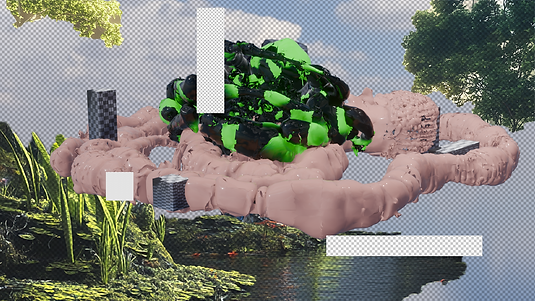
This piece focuses on the extraction and embeddedness of Rare Earth Elements— lithium, silicium, cobalt—within the broader context of planetary and organic systems. It reflects on how these materials, vital to modern technology, are tied to forms of life, respiration, and survival. The recurring transparency grid surfaces here as a quiet framework, evoking systems of control, structure, and design. The work suggests an uneasy proximity between what is considered natural and what is produced, shaped, or extracted—an early signal of an ontological glitch where the distinction between living organism and industrial resource begins to blur.
//ONTOLOGICAL_GLITCH:// 02 Disrupt /logic.corruption/
spirals into unreadable systems—logic liquefied, structure in recursive mutation.
In this second part, hybrid forms emerge—bodies that are neither fully organic nor entirely synthetic. Referencing mutation, assemblance, and adaptation, the work explores how systems and species transform under pressure. The transparency grid appears again, this time less stable, partially obscured or fragmented by the morphing figures that dominate the scene. Here, the grid no longer just supports visibility—it becomes part of the mutation itself. The piece reflects a transitional moment, where the boundaries between self and system, creator and created, are increasingly ambiguous.
//ONTOLOGICAL_GLITCH://03 Dissolve /output.void/
merges with the signal—autopoietic, consuming, unbound.
In the final part, the work explores a future in which systems have fully detached from human control. This is a space of total automation—a dynamic environment where autonomous entities emerge, evolve, and operate according to internal logics no longer shaped by human oversight. These entities engage in processes of digestion and transformation: not only consuming data, energy, and material, but also metabolizing fragments of the collective unconscious, filtered through vast neural networks and algorithmic structures.
The work draws from cybernetics, system theory, and autopoiesis to question what constitutes a “being” when intelligence becomes self-generating and self-sustaining. Rather than mimicking human behavior, these systems define their own parameters of existence. The subtle presence of the transparency grid lingers in the background— barely visible, nearly obsolete—symbolizing the fading influence of human-authored frameworks. What remains is a space where systems no longer reflect us but absorb us, shaping meaning from the remnants of thought, culture, and memory.
This piece closes the series with a profound ontological shift: a movement from designed systems to entities that design themselves, continuously rewriting the boundary between artificial and alive.
